As logotherapy teaches, there are three main avenues on which one arrives at meaning in life. The first is by creating a work or by doing a deed. The second is by experiencing something or encountering someone; in other words, meaning can be found not only in work but also in love. Edith Weisskopf-Joelson observed in this context that the logotherapeutic ‘notion that experiencing can be as valuable as achieving is therapeutic because it compensates for our one-sided emphasis on the external world of achievement at the expense of the internal world of experience;. Most important , however, is the third avenue to meaning in life: even the helpless victim of a hopeless situation, facing a fate he cannot change, may rise above himself, may grow beyond himself, and by so doing change himself. He may turn a personal tragedy into a triumph. (Viktor Frankl)
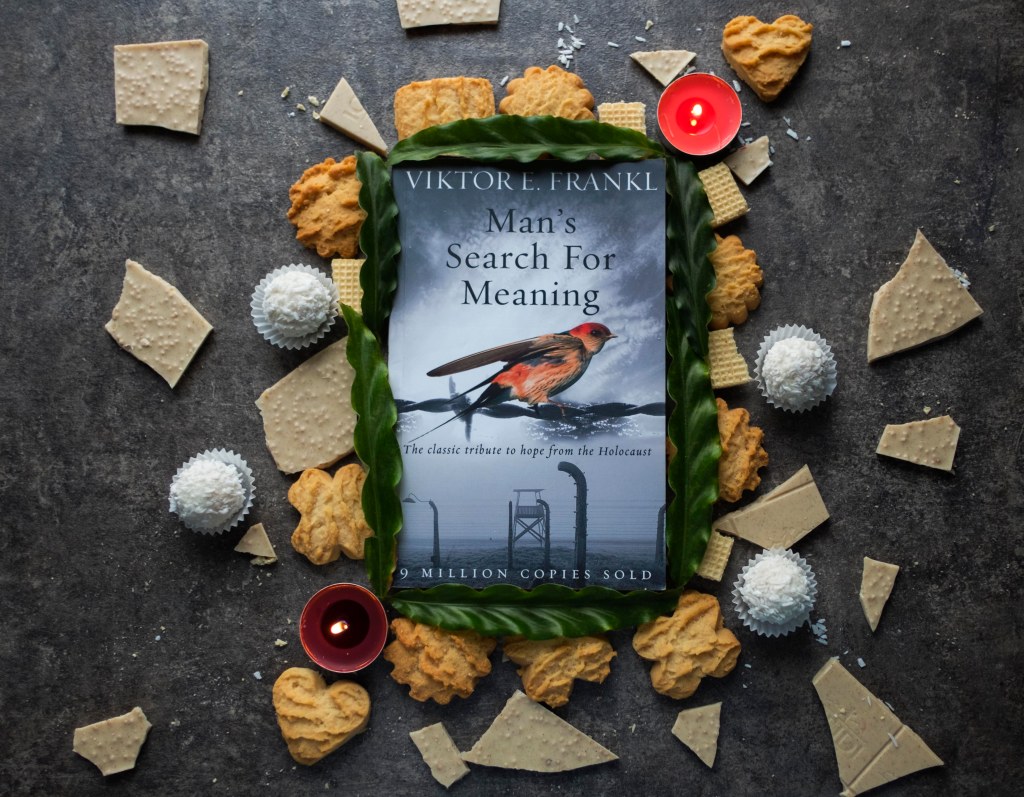
I am on my second reading of this book written by logotherapist Viktor Frankl:Man’s search for meaning.

I was thinking about the fact that this time ( I have read this book in 2019) I look at this as being more of an essay. I remember being horrified by the atrocities that happened in the camp during the Holocaust. Now I can read more clearly through those lines of horror and see the immense power of us humans to push through misery. There is meaning even in suffering and this is an idea that our society tries to shame in the sense that being unhappy is somehow wrong and it casts a shadow of shame upon the one that dares to be anything but filter-happy.

I believe that there is great truth in the moral imperative that Viktor gives in his book: Live as is you were living for the second time and had acted as wrongly the first time as you are about to act now. (Viktor Frankl)
We are more than what happens to us. There is humanity even in the most despicable human being and I think that there is very interesting approach to the human spirit that the author makes: the core of the human psyche remains always unknows. There is something we can never predict about humans. Even the most vicious criminal can show a different side to him years after he has commited the crime. Even the most psychotic individual in an asylum has this human core untouched despite his illness. I really like this view of Viktor Frankl and it is a perspective that opens the avenues to more in depth research of the human soul faced with the nihilistic perspective on life.

I have practiced my skills in photography and tried to make creative pictures for the book.

I also worked on a short intro film for it:
There is a very long review of this book I have posted on my Youtube channel and I invite you to watch it



Leave a comment