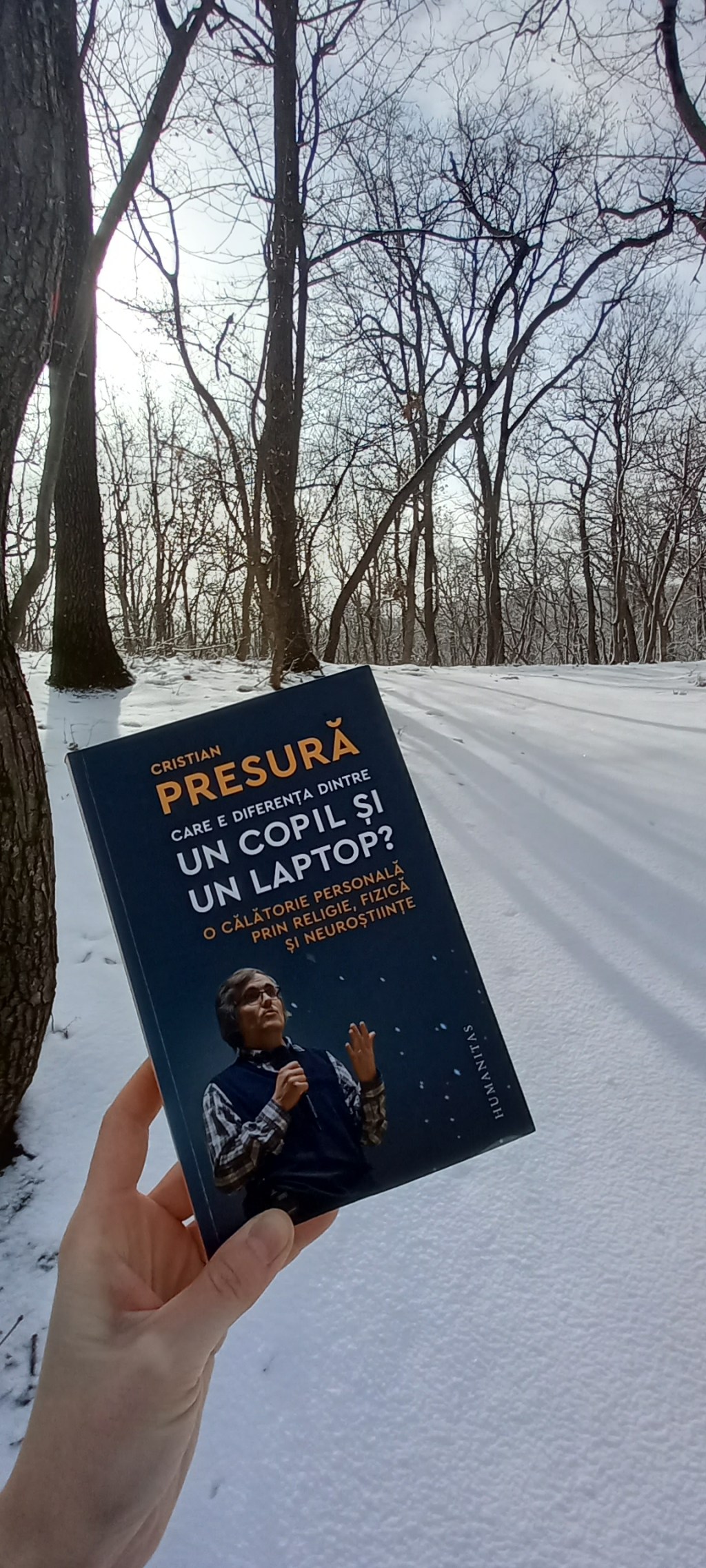
I must admit that this was an interesting reading for me because the author has managed to make quantum physics a very juicy topic. I have a strong belief that if all teachers of exact sciences would possess this fun, quirky manner of explaining complicated things in a simple way, all children would absolutely adore physics. The author is Cristian Presură and the book’s title is : What is the difference between a child and a laptop? A personal journey through religion, physics and neuroscience ( original title: Care e diferența dintre un copil și un laptop?O călătorie personală prin religie, fizică și neuroștiințe)
A quote about the incredible tiny thing that makes us think called brain really touched my heart:
There are hundreds of billions of galaxies in the universe, each containing hundreds of billions of stars. There are nearly a hundred billion neurons in the brain, each containing thousands of billions of atoms. This is why the number of atoms in the human brain is greater than the number of all the stars in the observable universe which, in turn, is greater than the number of grains of sand on all the beaches of the Earth
The book starts from a rather fun ( or not so fun for the author) experience. The author gave an interview and, as usual, some people took some snippets out of it and somehow the remark “a child is no different than a laptop” was attributed to the writer. Of course this is not what he said, but taking things out of context in order to create something that will attract reactions can be a norm in today’s media.
This is the book in which everything is cleared up and explained. I like the personal touch of the author on the topic of qualia. Pain humbles us. Pain shows us that we are alive. Atoms do not feel pain yet we are a mass made out of atoms and we all know how a broken heart feels.
We are taken on a journey through science, quantum fields, neuroscience, religion and spirituality. In the end I have remained in awe thinking about the vastness of this universe and how tiny we are in the big scheme of things.
I admit that , contrary to my own beliefs, the part where the author explains some heavy physics is my favourite. Who would have thought?
Another quote that I really loved from this book is about our universe :
We often forget that we are beings living our lives on one of the many planets of the universe. Each of us is just one of the billions of people on this planet, which is one of the billions of planets in the galaxy of the observable universe (the one seen in the sky). This, in turn, is a tiny part of an entire universe that we know for sure is at least a million times larger. That is why, very likely, the concepts we develop about the world bear the imprint of the planet we are on, the society we live in and the biological brain, which emerged as a result of natural evolution on this planet. It is then almost obvious that other civilizations, developed on other planets, will have different concepts.



Leave a comment